Research
My research asks how socio-ecological transformation unfolds through everyday life – through practices of care, social reproduction and collective experimentation rather than through policy, technology or institutional reform. Situated within critical geography, political ecology and feminist theory, it follows these practices across urban, rural and domestic spaces, and attends throughout to their more-than-human dimensions.
A critical commitment runs across all three strands below: I resist assessing initiatives as either radical or co-opted, and treat ambivalence as structural to transformative practice. Power, privilege and exclusion operate inside alternative spaces as much as outside them.
1. Prefigurative Politics and Socio-Ecological Transformation
I examine how grassroots initiatives – community food spaces, eco-communities, commons-based projects and autonomous collectives – pursue transformation by reorganising the everyday relations of work, care, learning and coexistence. Building on feminist political economy and on autonomous and post-capitalist geographies, this work foregrounds social reproduction and affective labour as infrastructures of change, and endurance – the capacity to persist through contradiction – as a form of political labour.
My published work in this area is based on ethnographic research in Berlin’s community food spaces, examining the strategies and politics of change these spaces pursue, and how classed, gendered and racialised inequalities are reproduced, contested or rendered invisible within practices of commoning and care. My current fieldwork extends this enquiry to rural eco-communities.
2. Care, Reproduction and Embodiment
A second strand approaches care, reproduction and embodiment as spatial and political processes. My published work here treats pregnancy as a geography in its own right – emotional and atmospheric, lived through domestic interiors, seasonal rhythms, clinical thresholds and writing – and argues for ambivalence and non-coherence as analytic grounds for emotional geography.
Ongoing research extends this to matrescence and to the institutional conditions under which research is produced, asking how embodied transitions reshape relations to space, time, work and knowledge, including within academic life itself.
3. Vegan and Antispeciesist Geographies
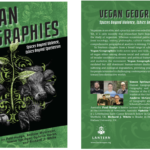
I am a co-editor of Vegan Geographies (Lantern Publishing & Media, 2022) and the author of Planète Végane. Penser, manger et agir autrement (Marabout, 2017). This strand approaches veganism not as an individual lifestyle choice but as a spatial, ethical and political praxis, produced through everyday negotiations, contestations and encounters across scales – from kitchens and families to activist movements and food economies.
Building on this, my work develops antispeciesist geographies: an approach that asks how spatial relations can serve to contest species hierarchies rather than reproduce them, and situates veganism within wider dynamics of capitalism, colonialism and ecological crisis. It contributes to debates in critical animal studies, political ecology, anarchist thought and feminist ethics of care.
Methodology
My research draws on participatory ethnography, minimally directive life-history interviews, focus groups, and reflexive feminist approaches. Alongside these, I mobilise longitudinal journalling as a method in its own right: not an auxiliary record but a feminist practice of inquiry that generates concepts from within embodied experience and traces transformation as it unfolds rather than in retrospect.
Earlier Work: Divided Cities
My doctoral research examined urban division as a dynamic political process, based on extensive fieldwork in Skopje. It introduced the concept of the dividing city to analyse how political narratives, redevelopment strategies and everyday practices actively produce – but also contest – urban division. This work continues to inform my interest in power, spatial inequality and resistance under neoliberal restructuring.